
The mechanics of the Hypogeum
How Roman engineers powered the Colosseum’s elevators
THE MECHANICS OF THE HYPOGEUM
How Roman engineers powered the Colosseum’s elevators

Introduciton
Have you ever asked yourself, what made the Colosseum so special? Was it the sheer size? The fact that it had room for 50,000 spectators? Fights to the death in front of bloodthirsty masses? All of these factors play a role, but what made the Colosseum tick was the intricate mechanics of its underbelly, the engineering wonders of the Hypogeum. Without it, the spectacle wouldn’t be possible.


Engineering the magic in the Hypogeum
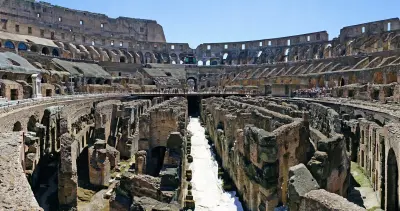
The incredible Colosseum hypogeum engineering allowed gladiators, wild animals, and various props to appear on the arena floor as if by magic. With hundreds of slaves, craftsmen, and engineers working in coordination down in the Hypogeum, the change of scenery was almost instantaneous. One scene would be a forest hunt, another set in hilly terrain, and later it would be the Sahara Desert.
The numerous elevators and systems of pulleys were carefully choreographed, resulting in dramatic and sudden appearances. This was made possible by dozens of trap doors spread across the arena floor. Imagine the surprise of the plebs, senators, and the emperor when some wild exotic animal just popped up in an unexpected corner of the arena. Now, imagine the shock of the gladiators when they realized that there’s a hungry lion right behind them. Yikes!
Wild animals were brought from all corners of the empire: elephants, lions, bears, bulls, hippos, rhinos, crocodiles, giraffes, the list was endless. They would be pitted against each other, or forced to fight condemned criminals, gladiators, and captured warriors in every possible combination. All that was done for the wow factor for the Roman masses. Who’s going to rebel against the regime that brought them all this exquisite entertainment? Exactly, and that was the whole point.
But how did it all work? What made the mechanism tick? And how come the ancient Roman engineers knew how to build it in the first place?

The mechanics of a spectacle
When Emperor Domitian ordered the construction of the Hypogeum, he employed the best Roman military engineers and architects available. Sadly, we don’t know their names because in those days it was considered the accomplishment of the emperor himself.
The builders divided the space beneath the arena, the Hypogeum, into sections using a large central corridor with fourteen passages on each side. Eight of those were straight, running parallel to the central axis, while the remaining six were elliptical, curving to follow the arena’s outer wall. These passages were intersected at right angles, extending along the length and width of the arena. In the central corridor there were twenty mobile platforms, which were mainly used to bring up the necessary props. However, near the outer wall, there were different types of platforms with cages. These held the wild animals who awaited their single, dramatic appearance in the arena.
A few hours before the spectacle, the gates of the cages would be raised, and the wild animals, one by one, were herded into a narrow passage. They could only move in one direction, toward the already prepared lift cages. On cue, these cages were hoisted to the next level using counterweights, and the animals were then driven out, ascending ramps and stairs to reach the open hatches through which they would suddenly burst into the arena.

How did they lift the cages?
Let’s take one example: a bear is in the cage, and he’s due to “perform” in a couple of minutes. That is, as soon as the carcasses of previous performers are taken away. He awaits his fate at the bottom level of one of the 28 lifts in the outer rim of the arena. The cage has two doors, one lateral, which is used to drag the animal inside, and the other in the front, which is used to release the animal once it reaches the trap door to the arena floor. The doors are secured by counterweights, preventing the animal from escaping too soon.
Eight slaves divided into two teams, stationed on a platform right next to the cage, operate the mechanism. They push the levers attached to the central pole, and they move in a circular fashion. The central pole has a drum on top of it, which is connected to the cage by a thick rope and a series of pulleys. As the caged bear ascends to the upper level, a rope and pulley system sets in motion the trap door mechanism. The ramp is lowered at a 45-degree angle, perfectly aligned with the front door of the cage, which is automatically opened. Now the bear has only one way to escape the cage: right on the arena floor.
PRO TIP
If you want to discover the fascinating world of the Hypogeum, make sure to check our Colosseum Underground Tour.
What will you see during the tour?
When you visit the Colosseum’s Hypogeum, you will see a confusing labyrinth of brick pillars, chambers, and corridors. You’ll have a chance to descend into the underworld where countless wild animals, gladiators, and slaves prepared to meet their end for the enjoyment of the crowds. Your tour guide will share riveting and chilling stories of day-to-day life in the dark underbelly of the Colosseum. However, by reading this blog post, we hope you’ll have a better grasp of the engineering aspect of the Hypogeum as well.

Bibliography: Miquel, Pierre. La Vie privée des Hommes: Au temps des Romains. Hachette, 1978.
Suetonius. The Twelve Caesars. Translated by Robert Graves. Revised by Michael Grant. London: Penguin Classics, 2007
Dio, Cassius. Roman History. Translated by Herbert Baldwin Foster. Cambridge, MA: Harvard University Press

We have the best value Colosseum tours & tickets for you!

Skip The Line
Colosseum Guided Tour
Book this guided tour and discover the symbol of Rome – the magnificent Colosseum. Be awed by its grandeur as you wander through the Roman Forum and Palatine Hill, where emperors once roamed. Let a passionate guide bring ancient Rome alive, revealing the intriguing secrets of its iconic ruins!

Limited Time Offer
Colosseum Underground Tour
Explore the hidden area of the Colosseum with this unique Underground Tour. Get access to sections that are unavailable with a standard ticket. Walk through the corridors where gladiators used to enter the underground area. Down there, you'll discover chambers, cages for wild animals, traps, and weapon storage.

Avoid the crowds
Colosseum Skip-the-Line Ticket
Visit the Colosseum with this skip-the-line entry ticket. Meet your host, who will guide you to the priority entrance for direct access to the Colosseum. Complete your visit by exploring the ancient ruins of the Roman Forum and climbing to Palatine Hill for a panoramic view of the Colosseum.